
Welfare gun loopholes face scrutiny over transfers to new owners
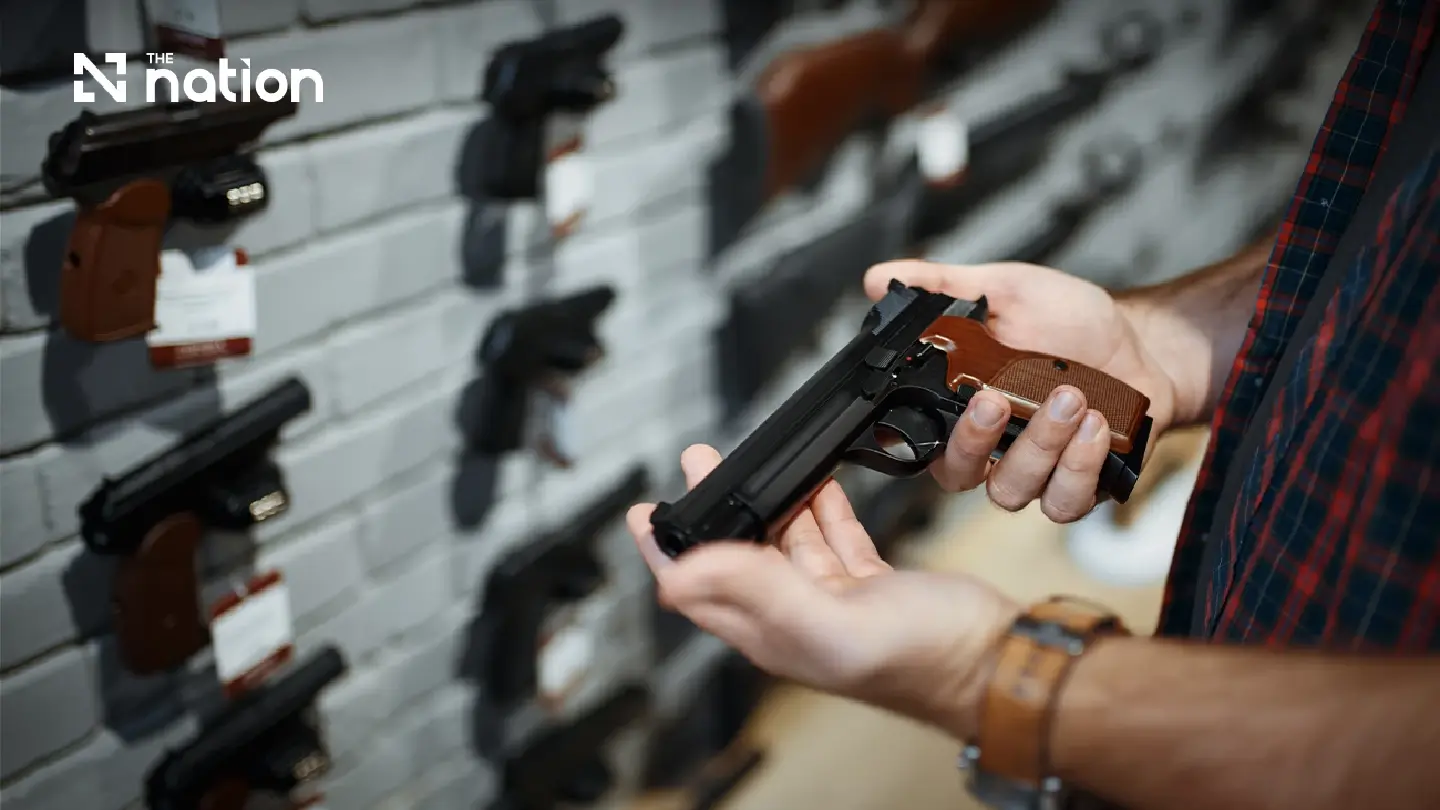


Five-year transfer rules, broad eligibility and corruption risks in welfare-firearm programmes are under scrutiny as Thailand tightens gun controls
- Thailand's welfare-firearm programs, which offer discounted guns to state personnel, are facing scrutiny over rules that govern the transfer of weapons to new owners.
- A key loophole under review is a five-year restriction on transfers, after which a firearm can be legally sold, potentially moving it from the intended group of buyers into the general public.
- An investigation by the National Anti-Corruption Commission (NACC) has uncovered administrative weaknesses and corruption, including forged documents and sales to ineligible people.
- In response, the NACC has proposed stricter controls, including better assessment of program necessity and tighter regulations on transfers to prevent firearms from reaching unintended hands.
Thailand’s welfare-firearm programmes are facing renewed scrutiny over rules governing who can buy the weapons, how many may enter civilian hands and what happens after a five-year restriction on transfers expires.
The issue has taken on greater significance as authorities reassess gun controls following a series of violent incidents, while official anti-corruption findings have identified problems ranging from forged documents and improper licensing to welfare firearms being sold to people who were not eligible to buy them through the programmes.
The National Anti-Corruption Commission (NACC) said complaints and investigations had identified cases in which officials allegedly produced or falsified documents connected with Por.3 purchase permits and Por.4 possession and use licences.
It also cited cases of welfare firearms being sold to ineligible buyers and government employees obtaining several handguns.
On June 23, the Cabinet acknowledged measures proposed by the NACC and instructed the Interior Ministry to lead further consideration with other agencies.
The recommendations call for stricter assessment of whether welfare-firearm programmes are necessary, closer scrutiny of extensions and tighter controls when exemptions allow gun dealers to import handguns through such schemes.
From staff benefit to wider access
Welfare-firearm programmes were created to allow civil servants and certain state personnel to obtain firearms for personal protection, protection of property and, for some officials, use connected with their duties.
The Department of Provincial Administration (DOPA) has operated some of the largest schemes, while welfare-firearm arrangements have also existed for police and military personnel.
DOPA documents show that eligibility under different programmes has extended beyond civil servants to categories including government employees, state-enterprise staff and personnel from participating government agencies.
The programmes offer eligible buyers access to firearms at prices below ordinary retail levels.
The NACC has identified that price difference as one factor requiring stronger safeguards because firearms acquired through welfare rights have subsequently appeared in cases involving improper transfers or sales to people outside the schemes.
One of the most debated rules concerns transfer of ownership.
A common welfare-firearm condition prohibits transfers for five years from the date the Por.4 licence is issued, except where ownership passes through inheritance.
Government security information has previously identified the rule as a potential loophole if firearms are purchased with the intention of transferring them after the restriction expires.
The five-year rule does not mean a welfare firearm automatically becomes illegal after changing hands.
Any subsequent transfer remains subject to firearm licensing requirements.
The concern raised by officials and researchers is that weapons initially supplied under preferential government schemes can eventually move beyond their original group of eligible buyers.
2009 changes opened way for more gun shops
Another major change came in 2009, when the Interior Ministry issued Order No.289/2552 governing firearms dealers and the quantities of firearms and ammunition permitted for trade.
The order is recorded in the parliamentary legislative information archive.
It replaced Interior Ministry Order No.109/2535 from 1992, which had restricted increases in the number of firearms dealers.
A parliamentary response subsequently recorded that there had been 335 gun-dealer licences before the earlier restriction.
After the 2009 order allowed applications for additional licences, 167 more licences were issued, taking the total at the time to 502.
The same records stated that individual dealer licences permitted sales of up to 50 long guns and 30 handguns, alongside specified ammunition quotas.
The changes were made during the government of then-prime minister Abhisit Vejjajiva, when Chavarat Charnvirakul was interior minister.
The expansion became politically contentious.
Opposition MPs questioned the granting of additional gun-shop licences, while Chavarat defended the policy at the time on the grounds that allowing more dealers would reduce market concentration, increase competition and bring down firearm prices.
Those political allegations did not, by themselves, establish wrongdoing.
The more recent NACC findings focus instead on weaknesses in administration and corruption risks within welfare-firearm programmes and recommend tighter controls.
Multiple schemes can expand access
The welfare system has also drawn scrutiny because purchase limits can apply to an individual project without necessarily creating a single lifetime ceiling covering every scheme.
DOPA has historically operated programmes serving different groups of government personnel, while police, military organisations and other state bodies have also had arrangements for eligible staff.
This has raised questions over whether an individual who qualifies for more than one scheme can accumulate firearms over time.
The NACC cited evidence of government employees obtaining several handguns and called for stronger controls on eligibility and the operation of welfare-firearm programmes.
The Interior Ministry’s licensing structure also places local registrars at the centre of the process.
Applicants generally require a Por.3 permit to purchase a firearm and subsequently a Por.4 licence to possess and use it.
Current government policy has tightened scrutiny at that stage.
In February, DOPA ordered registrars to conduct stricter checks on Por.3 applicants and to monitor existing Por.4 holders to ensure they remain qualified.
Thailand tops Southeast Asian rate in 2017 estimate
Thailand’s high level of civilian firearm ownership predates the latest debate over welfare programmes.
Small Arms Survey estimated that civilians in Thailand possessed 10.342 million firearms in 2017, equivalent to 15.1 guns for every 100 people. Of those, an estimated 6.221 million were registered and 4.121 million unregistered.
The 15.1-per-100 rate was the highest among Southeast Asian countries in that dataset, ahead of Cambodia at 4.5, the Philippines at 3.6 and Laos at 3.0. Myanmar and Vietnam were both estimated at 1.6.
The Small Arms Survey figures are estimates based on 2017 holdings, however, and should not be presented as a current 2026 count.
The organisation itself notes that firearm estimates can be affected by incomplete records and differences in available data.
Historical Thai government figures also illustrate how large the registered stock had already become.
A parliamentary response published in 2012 put legally held firearms at 6,221,180, comprising 3,744,877 handguns and 2,476,303 long guns.
Government reviews corruption safeguards
The NACC has not called simply for the abolition of all welfare-firearm programmes.
Its recommendations require government agencies to demonstrate the necessity and suitability of proposed programmes, ensure existing schemes comply strictly with the law and limit exemptions permitting handgun imports through welfare projects to cases where they are genuinely necessary.
The anti-corruption body also wants the Interior Ministry to establish implementation guidelines and report annually on progress.
The Cabinet has tasked the Interior Ministry with coordinating the review with the Defence Ministry, Finance Ministry, Royal Thai Police and Public Sector Anti-Corruption Commission.
The policy debate therefore extends beyond illegal firearms.
It includes how welfare weapons enter circulation, who qualifies to buy them, how ownership is monitored and whether rules on transfers and repeated participation in different schemes adequately prevent firearms supplied for official welfare purposes from moving into unintended hands.
Source: NationTV
